
Resource library
New BIA Appeal Rule: Deadlines and Federal Review
DOJ's November 2026 BIA rule takes effect December 17. Learn the 10-day deadline's asylum exception, issue-preservation risks, and federal review limits.
Published November 17, 2026 | AG Law Firm
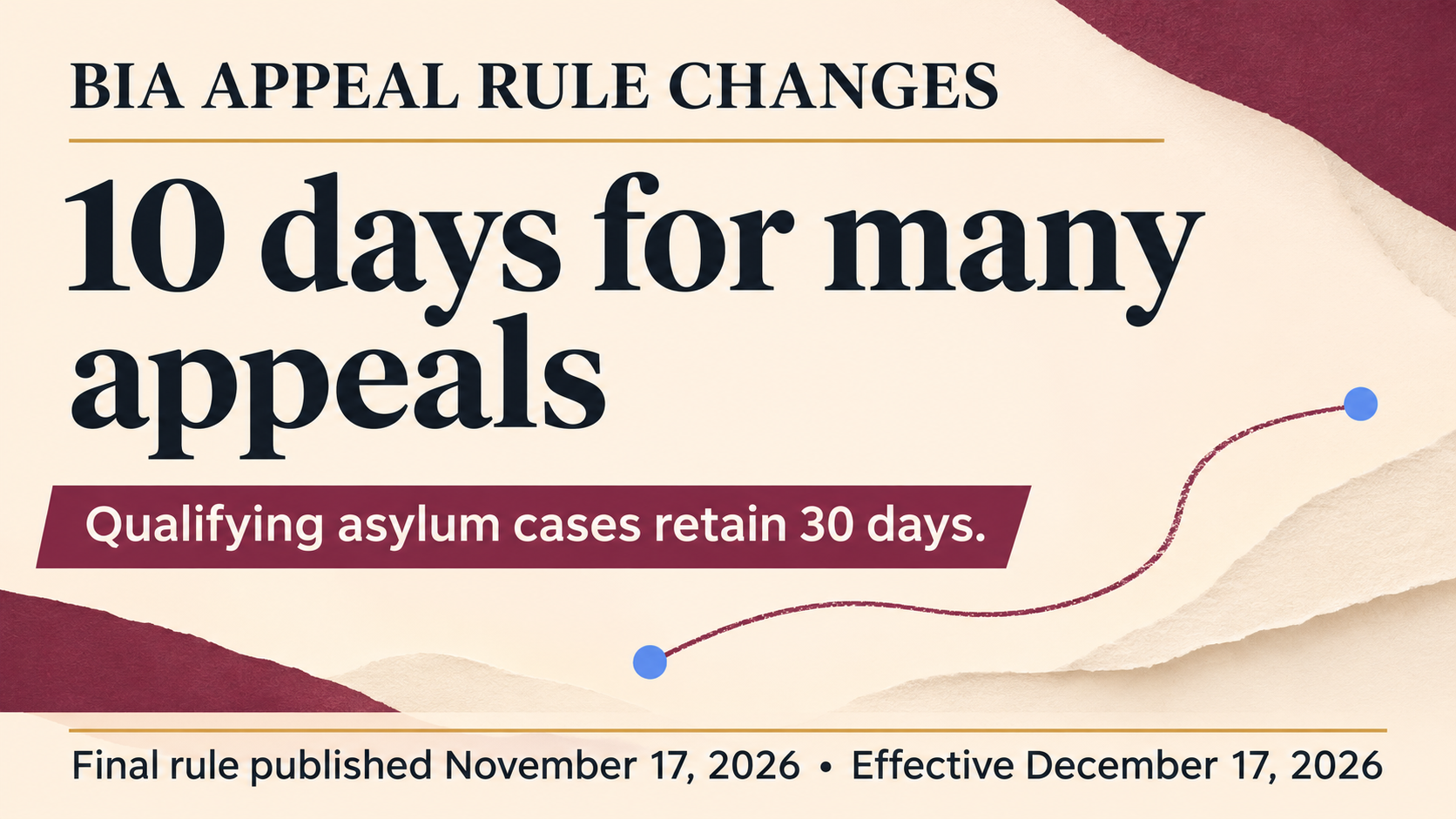
An immigration appeal can turn on what is filed at the very beginning. A new Justice Department final rule changes procedures at the Board of Immigration Appeals, or BIA. It sets a general 10-calendar-day deadline for appeals from immigration judge decisions, keeps a 30-day period for qualifying asylum cases, and makes early identification of disputed issues especially important.
The final rule was published November 17, 2026, at 91 Fed. Reg. 73876–73914 and states an effective date of December 17, 2026. Publication does not mean every person has only 10 days today. Have an attorney check the decision, applicable rule, transition issues, and any controlling court order promptly.
Read the official DOJ final rule, including its regulatory text and discussion of litigation.
What is the BIA?
The BIA is the administrative appeal body within the immigration court system. A BIA appeal is different from a Petition for Review filed in a federal circuit court. The two processes have different filing rules, and access to federal review depends on the particular order and issues.
Who has 10 days, and who keeps 30 days?
Under the rule's general provision, Form EOIR-26, the Notice of Appeal from an Immigration Judge's decision, must be filed directly with the BIA within 10 calendar days. Calendar days include weekends. If the last day is a Saturday, Sunday, or legal holiday, the regulatory deadline moves to the next business day.
The important exception is a case in which the immigration judge adjudicated an asylum application and did not deny it under INA section 208(a)(2)(A), (B), or (C). Those qualifying cases retain 30 calendar days. DOJ explains that this longer period covers the entire case, including accompanying withholding-of-removal and Convention Against Torture claims.
The three listed provisions concern a safe-third-country agreement, the one-year asylum filing bar, and a previously denied asylum application. DOJ says the 10-day period applies when asylum is denied on one of those grounds, including when the judge also gives an alternative reason addressing the merits. Simply having an asylum claim does not establish that the 30-day exception applies.
The clock is calculated from the date the judge states an oral decision, or from mailing or electronic notification of a written decision. A later written summary of an oral decision does not restart the clock. Do not wait for a transcript before having the deadline reviewed.
The deadline provision addresses appeals from immigration judge decisions. Appeals from DHS officer decisions retain separate filing procedures. The final rule also expressly sets a 10-calendar-day appeal period for practitioner disciplinary decisions issued on or after December 17, 2026. These different categories should not be treated as one universal deadline.
Why the Notice of Appeal needs careful preparation
The rule provides that an issue omitted from the Notice of Appeal is deemed waived. A notice should identify the specific factual findings or legal conclusions being challenged. A general statement that the judge was wrong may not tell the BIA what needs review.
DOJ says a full-length legal brief is not required with the notice. Even so, the notice must identify the issues with enough detail. Do not assume a later brief will cure an omission. Issue preservation at the BIA can also affect the arguments a federal court will consider.
What does summary dismissal mean?
For covered appeals of decisions issued on or after December 17, 2026, the final regulatory text makes dismissal without a written opinion the default unless a majority of the permanent BIA members votes to accept further review after briefing. A member may refer an appeal for that vote. The vote must occur within 10 days after filing, and the rule generally requires a written dismissal order within 15 days.
These are the Board's processing periods, separate from the person's deadline to file an appeal. The procedure excludes appeals under 8 CFR 1003.1(b)(5), (6), (7), and (14), including specified DHS decisions and custody matters. Required identity and security checks can also affect timing.
Under the new dismissal language, the decision below becomes the final agency determination. The dismissal does not necessarily approve every part of the judge's reasoning. This distinction matters when counsel evaluates possible federal review.
What happens if the BIA accepts further review?
The framework uses simultaneous briefing, generally within 20 days of the Board setting the schedule and, when needed, making the transcript available. Reply briefs are accepted only if invited or ordered. Extensions require exceptional circumstances and are discretionary. Counsel should follow the actual briefing notice.
Can a federal circuit court still review the case?
DOJ says the rule does not change the statutory system for federal court review or existing understandings of finality and Petition for Review timing. After a covered summary dismissal, DOJ expects the federal court to review the immigration judge's decision as the basis of the final order.
That is not a promise that every BIA decision can be challenged through a Petition for Review. Congress limits review of some orders and issues. Exhaustion, issue preservation, finality, the type of decision, and the controlling circuit's law all require individual analysis. The federal courts ultimately decide how the exhaustion statute applies.
For a reviewable final removal order, 8 U.S.C. section 1252(b)(1) generally provides a separate 30-day Petition for Review deadline. Filing a petition does not automatically stop removal. Any request for a stay requires separate attention. Do not skip the BIA process based on an assumption that direct federal review is available.
What about the court challenge to the earlier rule?
The final rule acknowledges that a federal district court partially vacated the February 2026 interim rule. The affected provisions were the shortened appeal period, waiver of issues omitted from the notice, and default summary dismissal. DOJ now takes the position that the final rule's notice-and-comment process addresses that procedural ruling and that the provisions are presumed operative on the effective date.
That is DOJ's position, not a guarantee about future litigation. The final rule expressly anticipates that a court could stay, enjoin, or invalidate a provision. Before relying on a deadline or procedure, counsel should check the law and orders controlling at that time.
How AG Law Firm can help
AG Law Firm handles BIA appeals and federal circuit Petitions for Review. A review can address the appeal deadline, the issues that need to be preserved, the judge's reasoning, and whether federal review or a stay request may be available in the particular case.
If you received an immigration judge or BIA decision, gather the complete decision, notices showing when it was issued or sent, prior filings, and any appeal paperwork. Contact counsel promptly rather than assuming that every case has either 10 or 30 days.
Learn about AG Law Firm's federal litigation and appeals practice.
Schedule a consultation with AG Law Firm.
This article provides general information, not legal advice. Viewing it or contacting the firm does not create an attorney-client relationship. Deadlines, available remedies, and outcomes depend on the individual facts and applicable law. No outcome is guaranteed.
Primary sources
8 U.S.C. section 1252, judicial review of orders of removal.
Talk with an attorney about your situation
Online information cannot account for your full immigration history, deadlines, prior filings, or safety concerns. A consultation is the place to review those details privately.
See the related practice area